
Top of funnel (TOFU) content gets strangers to see you. Middle of funnel (MOFU) content gets them to trust you. Bottom of funnel (BOFU) content gets them to act: click, message or buy.
You need all three, and each one is judged by a different number. Judge a bottom of funnel post by its views and you will kill the posts that actually make money.
Almost every account we audit has the same shape. Either it posts nothing but reach content and has a big audience that never buys, or it posts nothing but offers and wonders why nobody sees them. Both are the same mistake: content built for one stage of the funnel, with the other two missing.
Top, middle and bottom of funnel content is not marketing jargon for its own sake. It is the simplest way to check whether your content can actually take a stranger all the way to becoming a client. Here is how each stage works on social media, what it looks like in practice, and the numbers we use to judge it.
What is top, middle and bottom of funnel content?
A content funnel describes the path from "never heard of you" to "paid you". On social media it has three stages, and every post you publish belongs mainly to one of them.
- Top of funnel (TOFU): content for people who do not know you yet. The job is reach.
- Middle of funnel (MOFU): content for people who have seen you once or twice. The job is trust.
- Bottom of funnel (BOFU): content for people who already trust you. The job is action.
The reason this matters is simple: the algorithm, the audience and the goal are different at every stage. A post that works brilliantly at the top will often do nothing at the bottom, and the other way round.
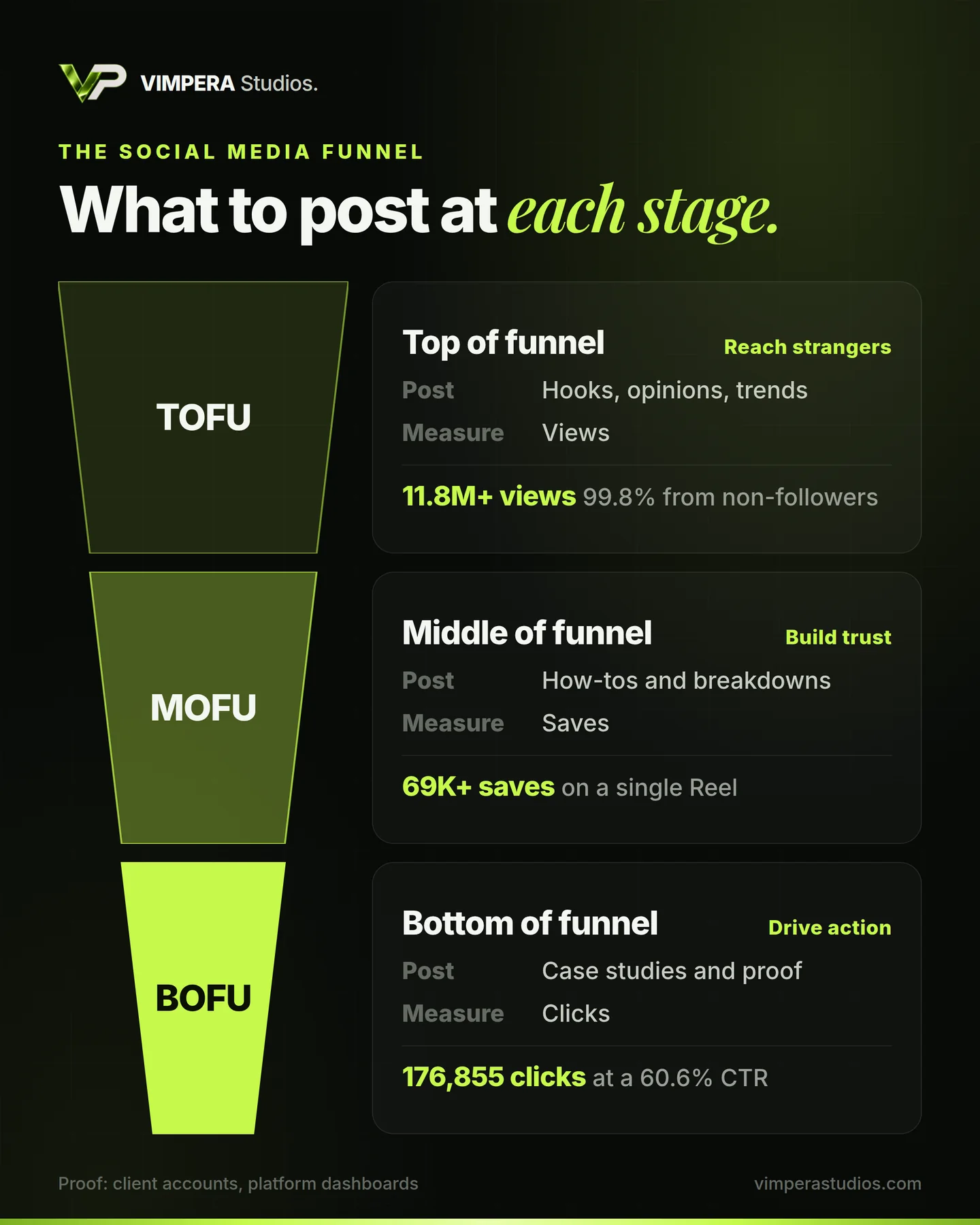
Top of funnel content: reaching people who have never heard of you
Top of funnel content is built for strangers. On short-form platforms that is almost everyone who sees your posts: on the accounts we run, between 97.7% and 99.8% of all views came from people who did not follow the account. We broke that down in how many followers you need to go viral.
That changes what top of funnel content has to do. It cannot rely on the viewer knowing who you are. It has to earn attention in the first second on its own.
Formats that work at the top:
- Broad, relatable hooks about a problem your audience has, not about you
- Myth-busting and strong opinions that people want to comment on
- Trends and formats adapted to your niche, not copied
- Short, fast videos with a payoff early enough that people finish them
What top of funnel content should not do: sell. A stranger who sees a pitch from an account they have never heard of scrolls. The job here is to be worth watching, nothing more.
Middle of funnel content: turning viewers into people who trust you
Middle of funnel content is for the people who stopped scrolling once and might come back. This is where most accounts leave a gap, because middle of funnel posts rarely go viral and so they feel like they are not working.
They are working. Their job is not reach. Their job is to make someone think "this person knows what they are talking about", and then save the post, follow, or come back tomorrow.
Formats that work in the middle:
- How-to content and frameworks that people save to use later
- Breakdowns of how you think, decide or work
- Behind the scenes of your process, your team, your day
- Carousels and longer videos that reward the viewer for staying
The signal to watch here is saves. A save means "I want this again", which is the clearest sign of trust a platform can measure. One Reel on a client account collected more than 69,000 saves, and that is the number that told us the audience was not just watching, they were keeping it.
Bottom of funnel content: turning trust into clicks and clients
Bottom of funnel content is for the people who already trust you and need one reason to act. This is where the money is made, and it is also where most creators and business owners feel uncomfortable, so they skip it.
Good bottom of funnel content rarely looks like an advert. It looks like proof.
- Case studies and results with real numbers and screenshots
- Client stories told from the client's point of view
- Offer explainers: what you do, who it is for, what happens next
- A clear call to action: a link, a keyword to comment, a DM, a booked call
What a working bottom of funnel looks like: on one client account, an organic Instagram funnel produced 324,597 link clicks, 176,855 of them high-intent, at a 60.6% click-through rate. No paid traffic at any stage. The reach came from the top of the funnel; the clicks came from bottom of funnel posts that gave an audience that already trusted the account a clear next step.
What our accounts show at each funnel stage
Here is how the three stages map onto real results from the accounts we manage. Every figure is from a platform dashboard published in our case studies.
| Stage | Job | Signal we watch | Result on a client account |
|---|---|---|---|
| Top of funnel | Reach strangers | Views, non-follower share | 11.8M+ views, 99.8% non-followers |
| Top of funnel | Reach from zero | Views, follower growth | 0 to 23,702 followers in 30 days |
| Middle of funnel | Build trust | Saves, follows | 69K+ saves on one Reel |
| Bottom of funnel | Drive action | Link clicks, CTR | 176,855 high-intent clicks, 60.6% CTR |
The stages come from different accounts, so the rows are not one single funnel. They show what each stage looks like when it is working.
How to build a full-funnel content plan
You do not need a complicated system. You need every stage covered every week, and a way to see which stage is the bottleneck.
- Start with a mix. Roughly 60% top, 30% middle and 10% bottom of funnel is a sensible starting point. It is a starting point, not a rule.
- Label every post before you make it. If you cannot say which stage it serves, it probably serves none.
- Connect the stages. Top of funnel posts should make people curious enough to visit your profile. Your profile and pinned posts should be middle and bottom of funnel content waiting for them.
- Give the bottom a destination. A link in bio, a comment keyword, a DM flow or a booking page. Bottom of funnel content without a next step is just another post.
- Read the right number for each stage and move your mix toward whichever stage is weakest.
Common funnel mistakes
- Only posting for reach. Big views, no buyers. The audience never gets a reason to go further.
- Only posting offers. Nobody new ever sees them, so the same small audience gets pitched until it stops watching.
- Judging every post by views. Bottom of funnel posts will always get fewer views. That is expected. Judge them by clicks.
- Skipping the middle. Jumping from a viral video straight to a sales post. The trust step is missing, so the click never comes.
- Spending the budget on polish instead of structure. A funnel with rough but clear content beats a beautiful account with no path. We wrote about why expensive productions often fail on short-form.
TOFU vs MOFU vs BOFU: how to measure each stage
The most useful thing you can take from this post is that each stage gets its own scorecard.
| TOFU | MOFU | BOFU | |
|---|---|---|---|
| Who sees it | Strangers | People who know you a little | People who trust you |
| Goal | Attention | Trust | Action |
| Main metric | Views, non-follower reach | Saves, follows, watch time | Clicks, DMs, bookings |
| Typical format | Hooks, opinions, trends | How-tos, breakdowns, behind the scenes | Case studies, proof, offer explainers |
| Expected views | Highest | Medium | Lowest, and that is fine |
Build it yourself or have it built for you
You can run a full-funnel content plan yourself. It takes a weekly plan, consistent filming, and the discipline to read three different sets of numbers instead of one.
Or you hand it to a team that already does it every day. That is what we do at VIMPERA Studios: we plan the mix, produce the content, and read the dashboards so the funnel keeps moving while you focus on your business. If you are a founder or business owner, our post on building a personal brand as a business owner shows what that looks like in practice.
FAQ: top, middle and bottom of funnel content
What is the difference between TOFU, MOFU and BOFU content?
Top of funnel (TOFU) content reaches people who have never heard of you. Middle of funnel (MOFU) content turns those viewers into followers who trust you. Bottom of funnel (BOFU) content turns that trust into a click, an enquiry or a sale. Each stage has a different job and is judged by a different number.
What percentage of my content should be top, middle and bottom of funnel?
A sensible starting mix is roughly 60% top, 30% middle and 10% bottom of funnel. Treat it as a starting point, not a rule: if reach is strong but nobody clicks, shift weight toward the bottom; if clicks convert but reach is flat, shift weight toward the top.
Is bottom of funnel content the same as a sales post?
No. Good bottom of funnel content rarely looks like an ad. Case studies, results with proof, behind-the-scenes of client work and a clear next step convert better than a hard pitch, because the viewer already trusts you by the time they see it.
How do I know which funnel stage a post belongs to?
Ask who the post is for and what you want them to do next. If it is for strangers and the goal is a view, it is top of funnel. If it is for people who already know you and the goal is a save or follow, it is middle. If the goal is a click, a DM or a booked call, it is bottom of funnel.